

When AI Builds Everything, Design Becomes Everything.
Why design is ceasing to be a job and becoming a fundamental leadership skill, and what that demands of organisations, leaders, and the universities still teaching the old model.

When AI builds everything, design becomes everything. That sentence sounds like optimism. It is not. It is a structural fact with uncomfortable implications for every design leader, every junior designer, every design school, and every organisation still treating design as a production function housed in a dedicated team.
Something important happened in Amsterdam in May 2026. Forty-odd design leaders gathered for two days of peer circles, spark talks and honest confrontation with what their work has become. They came from Miro, Atlassian, Intercom, Vinted, ING, Deel, to name a few. From defence, cybersecurity, HR tech and fintech. From large orgs and scale-ups. They came with different contexts and a shared anxiety: a feeling that the ground beneath design as a profession was moving fast, and that nobody had yet said clearly where it was moving to.
By the end of day two, two things had become unmistakably clear. First: design as a job title is in structural decline. Second: design as a human capacity is more urgently needed than at any point in living memory. These are not contradictory. They are two sides of the same transformation. When execution costs nothing, the only thing that retains value is the judgment that decides what gets executed, why it matters, and under what conditions it can exist responsibly. That judgment has a name. It has always had a name. We just spent thirty years filing it under a job description.
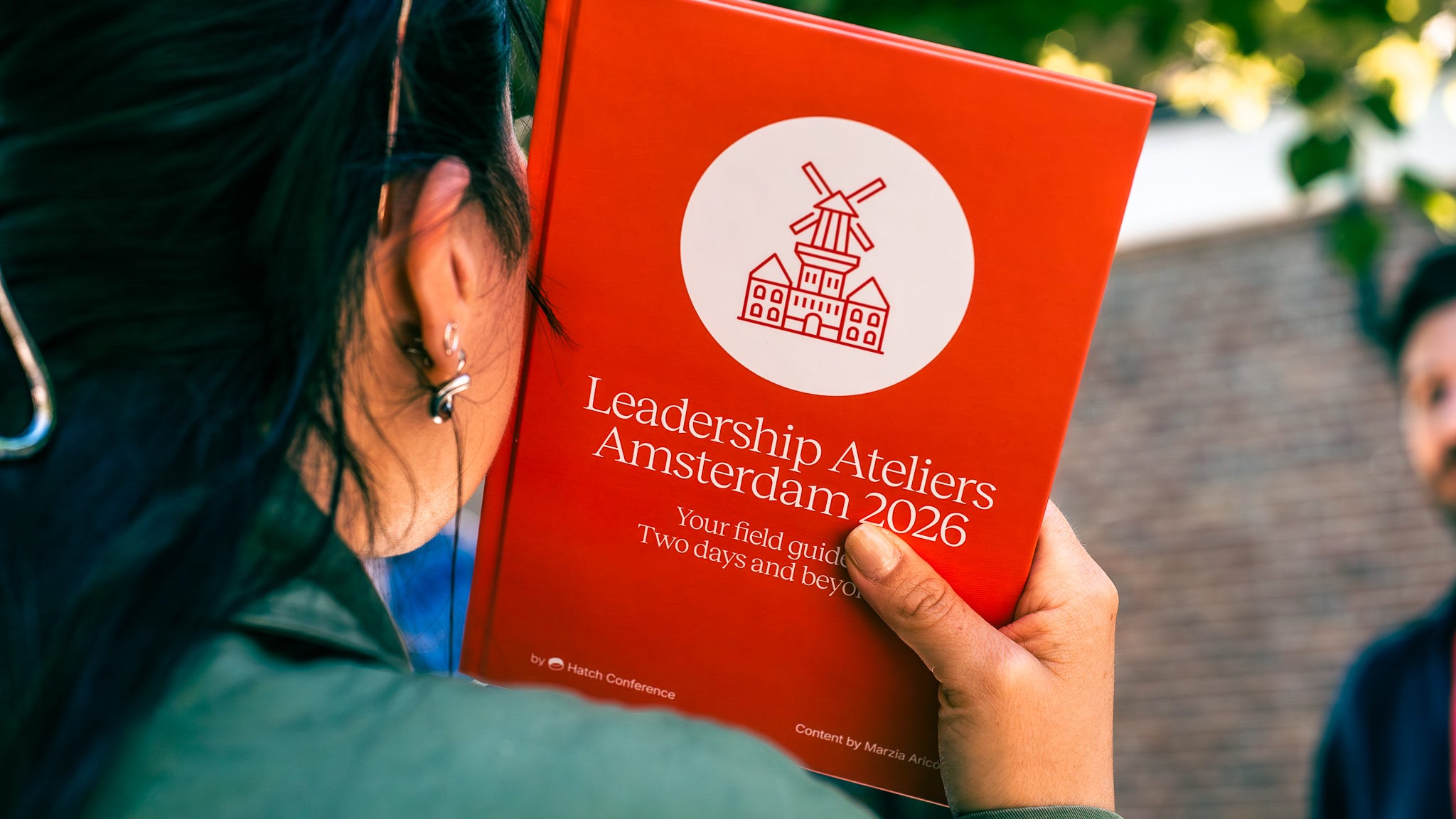
I was the lead coach for the event. The Leadership Ateliers Amsterdam 2026 was a two-day gathering dedicated entirely to AI and design leadership. Damian Martone and I designed the format together, and we made a deliberate choice that will strike some people as paradoxical for a conference about AI: it was completely analog. No slides running during the peer circles. No live demos competing for attention. No performative tech. Just people in a courtyard, sharing what they were actually experiencing, learning from each other's attempts and failures, building the kind of trust that only happens through genuine connection. We believed then, and believe more strongly now, that the only way to think clearly about what AI is doing to human work is to create the conditions where human work can speak for itself.
The job is dissolving. The skill is becoming foundational.
At Intercom, over 90% of pull requests are now authored by Claude Code. Thom Rimmer, VP of Product Design at Fin.ai, presented this data not as a threat but as a fact that rewrites the entire premise of what a design role is for. “The cost of building software has hit theoretical zero,” he told the room. When execution is free, the question that used to live in the background —what should we build, why does it matter, what does good look like— becomes the only question that still requires a human answer.
Thom’s talk, “When Execution is Free, Direction is Everything,” crystallised something the room had been circling for months. Speed is not the differentiator. Abundance is not clarity. When anyone can spin up a dozen ideas simultaneously and turn concepts into working product in hours, value moves entirely to something else: judgement and direction. His equation was precise and unsentimental. Speed without direction equals noise. Direction is the product.
David Hoang, VP of Design at Atlassian, made the same argument from the organisational side. Going AI-native, he was clear, is not about picking up new tools. It is not about email summaries and AI sparkles on your product. It is a fundamental shift in how product, platform and practice are organised to absorb constant change. “Avoid slapping AI sparkles everywhere. You need to change the foundational capabilities.” At Atlassian, 64% of his direct reports are now individual contributors. Every designer works as a platform designer. 32,028 prototypes made since July 2025. The mantra: Demo before the memo.
What both talks pointed at, without quite naming it directly, is this: the role boundary called “designer” was always a workaround. A way of housing a set of capabilities —understanding, synthesis, framing, quality, the ability to hold multiple futures in mind simultaneously— inside an organisational structure that valued headcount and specialisation. AI has not destroyed those capabilities. It has made the workaround obsolete. The capabilities themselves are being liberated from the container they were trapped in.
We saw this playing out in real time across the peer circles. One of the attendees put it as follows: “Design is growing into a skill and no longer needs to be a role.” Another attendee described herself as a “translator for the org, a dot connector,” trying to stay a trusted bridge when the ground keeps moving. A third attendee shared how he is building agents specifically to teach creativity and lateral thinking, because those are the skills the organisation cannot automate and cannot afford to lose. Thom, from the stage, landed the sentence that stayed with me longest: “Somewhere along the way, ‘people-first’ became ‘hands-off’. We trained a generation of leaders to stay out of the work. But the work is the only thing that ever mattered.”
The evidence in the industry corroborates it. The rise of the hyper-IC. Leaders transitioning back to individual contributor roles. Fewer managers, more curators. From headcount to delivery. From passenger to driver. This is not decline. It is liberation. Design is becoming what creativity and lateral thinking already are: a fundamental human capacity that successful leaders must carry, not delegate. A literacy, not a function.
This is why my working definition of design matters more now than it ever did in the era of the design role:
Design is the ability to generate alternative desirable futures and to make others believe in and own that very future.
Read that through this lens and what becomes visible is striking. Stakeholder centricity is not a UX technique. It is the practice of understanding whose future you are designing for. Prototyping is not a deliverable. It is the practice of making an abstract future tangible enough for others to inhabit. Iteration is not a process. It is epistemic humility in the face of uncertainty. Co-creation is not a workshop method. It is the recognition that futures people did not help build are futures they will not own. These are leadership capacities. They belong in every executive’s toolkit, not in a design team’s job description.
The real work is upstream. And almost no one is doing it.
The second shift is harder to see, and Giulio Frigieri named it with great precision. His Spark Talk on day one, “Prototyping the Conditions: Design as Governance,” did not ask what AI can do for designers. It asked the less examined question: what must design do for AI? And the answer upended the room’s assumptions about where design’s territory actually lies.
Giulio opened with a story most of the room recognised immediately. An AI agent drafts replies faster than humans. A model classifies claims with surprising accuracy. The demo lands. Leadership calls it a game changer. And then, quietly, nothing happens. The prototype stalls. The pilot disappears. Six months later, the same team is running the same demo for a different audience.
This pattern, he argued, is not bad luck. It is a structural failure of where design attention is being directed. The entire industry rewards designers for the quality of the prototype: the surface, the interaction, the interface. But “the AI prototype proves what is possible. It proves nothing about what is viable.” Here is what Frigieri said that stopped the room: the interface is downstream. The AI model is downstream. Even the product is downstream. What sits upstream, and what almost no design team is touching, is the design of the conditions that determine whether any of it holds when it meets the real organisation.
Those conditions have four dimensions:
Workflows: how does work actually move, and where are the human frictions?
Data pathways: where are the silos?
Decision rights: who owns what, and what accountability structures actually exist?
Controls: what triggers a handoff, what pauses the system, who answers when a complaint reaches the board?
These are not IT questions. They are not legal questions. They are design questions. Questions about intent, about the shape of human action, about what an organisation actually promised its customers and whether it can keep that promise when AI is executing on its behalf.
Giulio’s historical proof case was the factory electrification paradox. Factories electrified in the 1880s. For forty years, productivity barely moved. The electricity performed. The factory floor was still the old one, designed entirely for human action. It was not until the 1920s, when the conditions themselves were redesigned, a small motor per machine and assembly lines built around the actual flow of work, that productivity exploded. The technology was the same. The conditions were new. “Most AI today,” Giulio told the room, “is being attached to operating models that were mostly designed for human action only.” We are living in those first forty years. The question is whether we redesign the factory floor, or keep running demos.
What Giulio proposed as design’s new primary function is governance. Not in the compliance sense. In the generative sense:
Design as the practice that exposes operating reality, maps workflows, defines accountability structures, prototypes the conditions under which AI can act responsibly and profitably.
His formulation was unambiguous: there is no durable profit without responsibility in AI. Design is what turns both into tangible reality. Responsibility failure is commercial failure. They are the same outcome.
No model decides. No machine carries moral weight. The machine is never accountable. The organisations and the people always are.
This connects directly to what David was describing from the platform side and Thom from the product side. AI readiness is not a technology question. It is a design act. “Which 20% of our workflows generate 80% of our value?” is a design question. “Whose intent is actioned when an agent responds to a customer?” is a design question. “What does good look like when the interface has disappeared?” is a design question. Three talks, three different contexts, one convergent argument: design has to move upstream, into the conditions, into the governance, into the decisions that determine whether any of the downstream work is worth doing.
In the peer circles, we heard this pressure in real voices. One of the attendees, navigating a pre-IPO sprint: “Am I supposed to do that?” A question that contains the entire problem of a designer with no mandate to operate where the actual work lives. Another attendee from defence and cybersecurity, asking whether her job is to accelerate or to protect, and finding that nobody above her has defined the conditions under which acceleration is acceptable. The field guide we built for the event named this condition: The Frozen Middle. No strategic guidance from senior leadership, no infrastructure for sharing what is being learned, no common framework for what good looks like. Everyone is experimenting, largely alone.
The designers who are suffering most are not the ones who cannot use AI. They are the ones who can see exactly what needs to be done upstream and have no mandate, no language, and no career path to go do it.
Dear design schools: the curriculum you are teaching is preparing people for a world that no longer exists.
I want to say this directly, because no one else seems to be saying it loudly enough.
The standard design curriculum was built around a model of design as a specialised production function. You learn the craft. You join a team. You make things. That model is ending. Not next year. Now. What we need is not a minor update to the syllabus. We need a fundamental reconception of what design education is preparing people to do.
Stop centring tool mastery as a core competency. Figma, the next Figma, tools change every cycle. Teaching students to be expert tool operators is training them for obsolescence. AI fluency matters, but fluency is not mastery of a tool. It is judgement about when and how to use any tool in service of a direction.
Start centring direction-setting as the primary skill. What are we building? Why does it matter? What does good look like? These are the questions Thom identified as design’s irreducible contribution. Every student should leave a design programme able to frame a problem, articulate a direction, and defend a quality standard with precision.
Stop centring the portfolio as proof of craft. Portfolios of polished screens assess the wrong thing. They reward surface over substance and train students to optimise for visual approval rather than organisational impact. When the screen disappears, the portfolio disappears with it.
Start centring conditions prototyping. Students should learn to prototype workflows, accountability structures, decision rights and governance frameworks, not just interfaces. Following Giulio’s framework: name the customer promise, map the workflow, identify accountability, define the evidence needed to continue. This is design work. It belongs in every studio course.
Stop centring design as a discipline unto itself. The siloed design programme, separate from business, ethics, organisational theory, systems thinking, produces designers who are fluent in craft and illiterate in context. The context is now the work.
Start centring design as leadership literacy. Every MBA student learns finance and strategy. Every design student should learn organisational dynamics, stakeholder alignment, AI governance and ethical accountability. Not as electives. As core. Because these are not adjacent skills. They are the operating context in which design judgement is exercised.
Stop centring the handoff as an endpoint. Design education still largely treats the deliverable as the end of the designer’s responsibility. Specs are handed off. The designer’s job is done. This trains designers to be passengers in their own work’s consequences.
Start centring ownership through the full system. One of the attendees’ reflection from the peer circles was the clearest formulation of what needs to change: “Learn how to think vs how to execute. From managing outputs to inputs.” Design education needs to produce people who understand that the future they designed for continues after the prototype ships, and that they are accountable for whether it is actually desirable.
The conversation at the Ateliers that stayed with me longest came from a participant who described themselves as a “bridge with no ground.” Trying to translate between AI capabilities and organisational reality. Trying to stay trusted by both sides. Trying to be the person who holds the conditions together when everything else is moving. This person had no name for what they were doing, no career path that described it, no university module that had prepared them for it.
That is the designer of 2026. Translating. Governing. Holding the conditions. Making futures legible to the people who have to own them.
We are training people for a job. We should be cultivating a capacity.
The most important design question of our time is not “what should this look like?”
It is: under what conditions can this exist responsibly? Who is accountable when it fails? What future are we generating, and have the people who will live in it been given the chance to own it?
Thom Rimmer showed us that when execution is free, direction is everything. David Hoang showed us that AI-native organisations are built on practice, platform and product, and that adaptive leadership is what holds them together. Giulio Frigieri showed us that the conditions upstream are where design’s highest contribution now lives, and that without those conditions, every prototype is a promise without a foundation.
Together they articulated something I have been trying to say for years in a language the industry would recognise: design is not a job. It is a fundamental human practice of generating desirable futures and building the collective belief that makes those futures possible. It always was. The tools changed. The org charts changed. AI arrived and rewrote the economics of execution. None of that changed what design actually is.
What has changed is that we can no longer afford to hide it inside a role description. The capacity has to be distributed. Into leadership. Into governance. Into every person in an organisation who is making decisions about what the future should look like and who should believe in it.
On point! Now please apply for the dean position of the tudelft faculty of industrial design
Thank you Marzia